Imagine the lights flickering, then plunging your home into darkness. The refrigerator hums to a halt, the Wi-Fi dies, and that vital medical device suddenly has no power. For many homeowners, a power outage isn't just an inconvenience; it's a disruption to comfort, safety, and daily life. That's where a reliable home backup generator comes in. But with so many options, choosing the right generator for home backup can feel overwhelming.
Don't let the technical jargon deter you. This guide will walk you through everything you need to know, from understanding different generator types to precisely calculating the wattage your home needs. By the end, you'll be equipped with the knowledge to make an informed decision, ensuring your home stays powered when the grid goes dark.
At a Glance: Your Generator Decision Checklist
- Assess Your Needs: What absolutely must stay on during an outage? Lights, fridge, well pump, medical devices?
- Calculate Your Watts: Add up running watts for essentials, then factor in extra "starting watts" for motor-driven appliances.
- Choose Your Type:
- Portable: More affordable, flexible, good for occasional outages or specific circuits. Requires manual setup.
- Standby: Automatic, permanent, powers whole house, ideal for frequent/long outages. Higher upfront cost.
- Consider Fuel: Gasoline, propane, natural gas – each has pros and cons for storage and availability.
- Safety First: Always operate generators outdoors, far from your home, and ensure CO safety features.
- Professional Help: For standby units or connecting to your home’s electrical panel, always hire a licensed electrician.
Understanding Your Backup Options: Portable vs. Standby Generators
When you’re staring down an impending storm or a grid prone to hiccups, your first decision is often between two main types of generators: portable or standby. Each offers distinct advantages and caters to different needs and budgets.
Portable Generators: Flexibility for Focused Power
Think of portable generators as your robust, on-demand power station. They’re designed to be moved, started manually, and typically run on gasoline or propane. They're a fantastic choice for those who experience less frequent outages, want to power specific essential appliances, or need a more budget-friendly solution.
Connecting a Portable Generator:
You have a couple of primary ways to connect a portable generator:
- Direct Connection via Extension Cords: This is the simplest method. You run heavy-duty extension cords directly from the generator to individual appliances like your refrigerator, a lamp, or a phone charger. It’s straightforward but means you’re powering items one by one.
- Manual Transfer Switch: For a more integrated solution, an electrician can install a manual transfer switch and a subpanel. This allows you to safely connect your generator to your home's electrical system, powering specific, pre-selected circuits (like your kitchen outlets or well pump) with the flip of a switch, without using extension cords throughout the house. This method is safer and more convenient for handling multiple critical loads.
Portable Generator Subtypes & What They Offer:
- Conventional Portable Generators: These are the workhorses. They offer significant power for their price, making them a great value. However, they can be quite noisy and aren't always the most fuel-efficient.
- Wattage & Cost: You'll find models ranging from a few hundred dollars for basic camping units (under 200 watts) to thousands of dollars for home-ready units. A robust 4,500-watt dual-fuel model, capable of running a fridge, a window A/C unit, and some electronics, might cost around $1,000. Larger units, pushing up to 8,500 watts, can cost $950-$2,000 and are often gasoline-powered, weighing around 250 lbs.
- Best For: Powering a handful of essential items during occasional outages, tool use on job sites, or recreational activities.
- Inverter Generators: These are the quieter, more refined cousins of conventional portables. They use advanced electronics to produce "clean" power, which is ideal for sensitive electronics like laptops, smart TVs, and medical devices. They're also more fuel-efficient because they can throttle their engine speed based on the power demand, rather than running at full tilt all the time.
- Small Inverter (Up to 2,000 watts, $450-$1,600): Lightweight and very quiet, these are perfect for keeping a refrigerator running, some lights on, and charging phones. They’re easy to store and transport and can often be linked (paralleled) with a second unit for more power. They cannot connect to your home's breaker panel.
- Midsized Inverter (2,000-3,500 watts, $500-$2,400): A step up in power, these are still relatively quiet and lightweight. They’re efficient, often running for 8-25 hours on 2-3 gallons of gas for typical fridge and lighting loads. They handle most 110-volt items but typically aren’t powerful enough for large appliances like well pumps or HVAC systems without specialized (and often impractical) kits.
- Large Inverter (5,000-7,500 watts, $1,300-$7,000): These offer the best of both worlds: quiet operation, excellent fuel efficiency, and steady power output. They can run critical appliances like a fridge, furnace, lights, and even a smaller central A/C unit. Crucially, many large inverter generators can be connected to your home's breaker panel via a manual transfer switch, allowing them to power hardwired equipment like well pumps.
Standby Generators: Seamless, Whole-Home Automation
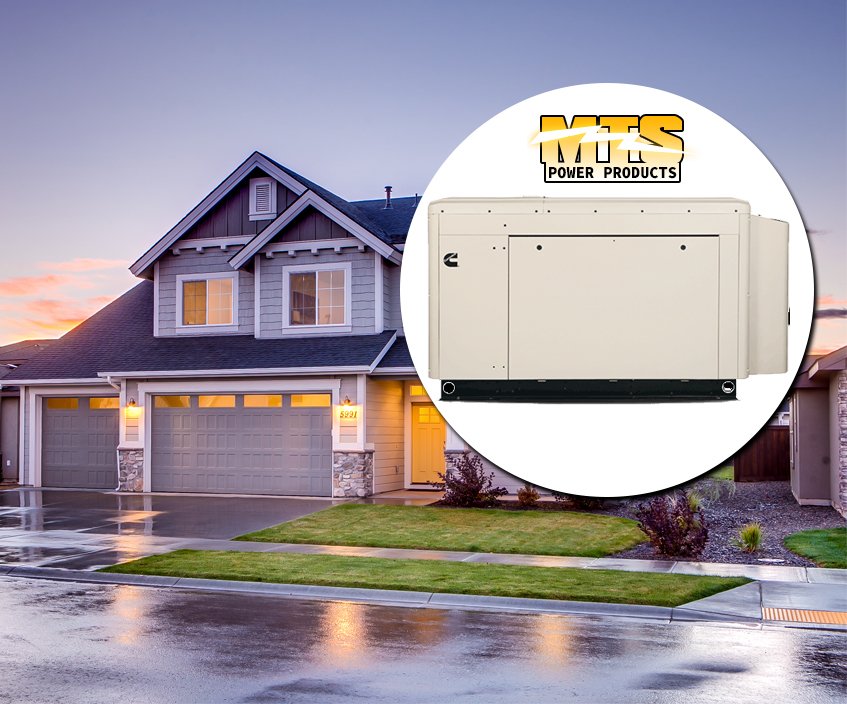
For ultimate peace of mind and hands-off operation, a standby generator is the gold standard. These are permanently installed units that act as an automatic backup power source for your entire home.
How They Work:
Standby generators are wired directly into your home's electrical system, typically fueled by natural gas or a large, underground propane tank. When the power goes out, an automatic transfer switch (ATS) immediately detects the outage, signals the generator to start, and seamlessly switches your home's power source to the generator. When grid power returns, the ATS switches back and shuts the generator down. You literally don't have to lift a finger.
Wattage & Cost:
Standby units are significantly more powerful than most portable models, ranging from 7,500 to 48,000+ watts (though residential models typically top out around 20,000 watts). The units themselves can cost $2,000 to $6,000. However, the real cost lies in professional installation. This is a complex job requiring a licensed electrician and possibly a plumber or gas fitter for gas line connections. Installation involves a concrete pad, electrical wiring, the automatic transfer switch, and fuel line connections. Total costs can easily range from $5,000 to over $25,000.
Benefits:
- Automatic Operation: No manual setup, refueling, or starting needed.
- Whole-Home Power: Can power everything from central air conditioning to kitchen appliances and sump pumps simultaneously.
- Continuous Fuel: Runs on your home's natural gas line or a large propane tank, eliminating frequent refueling.
- Quieter: Generally quieter than conventional portable generators.
- Enhanced Safety: No extension cords, no carbon monoxide risk from indoor operation (as they're permanently installed outdoors).
Limitations: - High Upfront Cost: Both the unit and installation are substantial investments.
- Permanent Installation: Cannot be moved once installed.
- Location Restrictions: Cannot be installed in low-lying, flood-prone areas.
How to Choose the Right Size Generator: The Wattage Whisperer
One of the most critical steps in choosing a generator is determining the correct wattage. Too small, and your essential appliances won't run. Too large, and you're paying for capacity you don't need. Let’s break it down into a simple, three-step process.
Step 1: List Your Non-Negotiables
Grab a pen and paper or open a spreadsheet. Walk through your home and make a comprehensive list of every appliance, device, and system you absolutely need to power during an outage. Don't forget critical medical devices, communication equipment, and well pumps or sump pumps if you rely on them.
Common Essentials:
- Refrigerator/Freezer
- Lights (at least a few)
- Sump Pump / Well Pump
- Furnace Fan / Space Heater
- Window Air Conditioner / Central AC (if budget allows)
- Microwave
- Computer / Wi-Fi Router
- Television
- Phone Chargers
- Medical devices (CPAP, oxygen concentrator, etc.)
Step 2: Calculate Running Wattage
For each item on your list, find its wattage. This is usually listed on a label or in the owner's manual. Look for "rated watts," "running watts," or "operating watts."
- If you find Watts (W): Great! Just note that number.
- If you only find Amps (A): No problem. Multiply the amps by 120 volts (standard household voltage) to get the wattage.
- Example: 10 Amps x 120 Volts = 1,200 Watts
- If you can't find either: Use the general guidelines below, but understand these are estimates.
Once you have the running wattage for each item, sum them up. This total is your total running wattage.
Step 3: Account for Starting/Surge Watts
Many appliances, especially those with electric motors (like refrigerators, air conditioners, and well pumps), require a brief burst of extra power when they first start up. This is called "starting watts" or "surge watts," and it can be 2-3 times higher than their running wattage.
To safely account for this, you'll need to identify the highest starting wattage item on your list. A common rule of thumb is to multiply the running watts of motor-driven appliances by 1.5x to 2x for a rough estimate of their starting wattage.
How to calculate total needed wattage:
- Sum the running watts of all appliances you want to run simultaneously.
- Identify the single largest starting wattage appliance on your list.
- Add this largest starting wattage to your total running wattage.
- Example:
- Total Running Watts (all items): 3,000 W
- Largest Starting Wattage Appliance (e.g., refrigerator): 700 W running, 1,400 W starting
- Total Generator Capacity Needed: 3,000 W (running) + 1,400 W (largest starting surge) = 4,400 W
Pro Tip: The 75% Rule
To prolong the life of your generator and ensure optimal performance, it’s wise to operate it at about 75% of its maximum capacity or less. This provides a buffer for minor fluctuations and prevents overworking the engine. So, if your calculated total needed wattage is 4,400 W, consider a generator with at least 5,500-6,000 running watts. A slightly larger generator is always better than one that is too small.
Wattage of Common Appliances (General Guidelines)
| Appliance | Running Watts (Average Range) | Starting Watts (Approximate) |
|---|---|---|
| Refrigerator | 300 - 800 W | 600 - 1,200 W |
| Microwave | 800 - 1,200 W | N/A (resistive load) |
| Television | 50 - 200 W | N/A |
| Laptop Computer | 50 - 100 W | N/A |
| Window Air Conditioner | 600 - 1,500 W | 1,800 - 4,500 W |
| Sump Pump | 800 - 1,000 W | 1,600 - 3,000 W |
| Furnace Fan (Blower) | 700 - 1,000 W | 1,400 - 2,000 W |
| Well Pump (1/2 HP) | 1,000 - 1,500 W | 2,000 - 4,000 W |
| Light Bulb (LED) | 10 - 20 W | N/A |
| Phone Charger | 5 - 10 W | N/A |
Matching Generator Type to Your Outage Reality
Your location and typical weather patterns play a huge role in deciding which generator is right for you. Do you get a rare, hour-long flicker, or are week-long blackouts a regular occurrence?
For Rare, Short-Term Outages (Peace of Mind for a Few Items)
If power outages are infrequent and usually resolved quickly, you likely only need to keep a few key items running for comfort and basic function.
- Best Fit:
- Small to Midsized Inverter Generator: These are compact, relatively quiet, and fuel-efficient. A midsized inverter (2,000-3,500 watts) can comfortably handle your refrigerator, some lights, a phone charger, and maybe a small window A/C or space heater. A small inverter (up to 2,000 watts) is excellent for lights, phones, and a compact fridge. They require manual setup and refueling, but for rare events, the convenience of portability and lower cost often outweighs the effort.
For Occasional, Sometimes Sustained Power Outages
Perhaps you live in an area that gets a few major storms a year, leading to outages that can last for several hours to a day or two. Here, you want more robust power and the ability to connect to more critical home systems.
- Best Fit:
- Large Inverter Generator (5,000-7,500 watts): Offers a good balance of power, efficiency, and quieter operation. It can run a fridge, lights, furnace fan, and possibly even a small central A/C.
- Large Conventional Portable Generator (5,000-8,500 watts): These offer excellent power-to-cost ratio. While noisier and less fuel-efficient than inverters, they can handle a significant load.
- Recommendation: For either of these, a professional installation of a manual transfer switch is highly recommended. This allows you to safely power hardwired appliances like your well pump or furnace directly from your home's breaker panel, saving you from running multiple extension cords. This setup can save you thousands compared to a standby unit if you're willing to handle the manual setup.
For Frequent or Prolonged Power Outages (Areas Prone to Severe Weather)
If you live in a region regularly hit by severe weather (hurricanes, blizzards, ice storms) that can knock out power for days or even weeks, or if you simply cannot afford any interruption, hands-free whole-home power is your priority.
- Best Fit:
- Home Standby Generator: This is the ultimate solution. It kicks on automatically, fuels itself from your natural gas line or large propane tank, and can power your entire household—central heat and AC, all kitchen appliances, well pumps, electric ranges, and medical equipment. While the initial investment is significant ($5,000-$25,000+ installed), the peace of mind and seamless operation are invaluable for frequent, prolonged outages.
- Consider a Large Inverter or Large Portable Generator with Transfer Switch: If a standby generator is out of budget, a powerful portable or large inverter generator, paired with a professionally installed manual transfer switch, can still provide significant backup for critical loads, including hardwired equipment. It requires manual intervention but offers substantial power for an extended period.
Crucial Considerations: Installation & Safety Guidelines
Getting the right generator is only half the battle. Proper installation, maintenance, and adherence to safety protocols are paramount to ensure your generator operates reliably and safely.
Professional Installation: Don't DIY Electrical Work
For standby generators, professional installation by a licensed electrician (and often a plumber/gas fitter) is not just recommended, it's mandatory. This ensures all electrical and fuel connections comply with local codes and safety standards.
Even for large portable or inverter generators, if you plan to connect them to your home's electrical panel via a transfer switch (manual or automatic), you must hire a licensed electrician. Incorrect wiring can be incredibly dangerous, leading to electrical hazards, damage to your home's systems, or even "backfeeding" power onto the utility grid, which can fatally injure utility workers. Understanding how to wire a generator to your house safely is complex and best left to certified professionals. Budget for these installation costs, as they can add significantly to your total investment.
Regular Maintenance: Keep It Ready
A generator is an engine, and like any engine, it needs regular care.
- Before Outages: Perform maintenance checks, especially before peak outage seasons (e.g., hurricane season, winter).
- Routine Checks: Follow the manufacturer's recommendations for oil changes, spark plug replacements, air filter cleaning, and battery checks (for electric start models).
- Test Runs: Run your generator periodically (e.g., once a month for 15-30 minutes under a light load) to keep components lubricated, charge the battery, and ensure it's ready when you need it. Standby generators often have an automatic exercise mode for this purpose.
Carbon Monoxide (CO) Safety: The Silent Killer
This is non-negotiable. Portable generators produce carbon monoxide, an odorless, colorless, and deadly gas.
- Location, Location, Location: NEVER operate a portable generator indoors, including garages, carports, or basements. Always operate it a minimum of 20 feet from your home, with the exhaust directed away from any windows, doors, or air conditioning vents.
- CO Sensors: Ensure your portable generator is equipped with Carbon Monoxide (CO) safety technology. Many modern units feature a built-in sensor that automatically shuts off the generator if dangerous CO levels are detected near the unit. Even with these features, always use a separate, battery-operated CO detector inside your home.
Fuel Storage: Safety and Shelf Life
- Gasoline: Store gasoline in approved containers in a cool, well-ventilated area away from living spaces and heat sources. Use fuel stabilizer to extend shelf life, as untreated gasoline can degrade and gum up your generator's carburetor within months.
- Propane: Propane tanks should be stored outdoors in a secure, upright position. Ensure tanks are not exposed to extreme heat. Propane has a virtually indefinite shelf life.
- Natural Gas: Standby generators running on natural gas benefit from an uninterrupted fuel supply directly from your home's utility, eliminating the need for on-site fuel storage.
Final Spark: Empowering Your Home Backup Decision
Choosing the right generator for your home backup is an investment in peace of mind, comfort, and safety. It's about empowering your household to weather any storm, maintaining critical functions, and staying connected when the world outside goes dark.
By carefully assessing your needs, precisely calculating your wattage requirements, understanding the capabilities and limitations of portable versus standby units, and prioritizing safe installation and operation, you can confidently select the generator that best fits your lifestyle and budget. Don't wait for the next outage to make this crucial decision. Take action today, and ensure your home remains a beacon of light and warmth, no matter what comes your way.